
Stock market minnows put up a stellar show in 2021 giving returns of up to 60 per cent amid Dalal Street dream run and are likely to continue sailing northwards in the New Year too. Trumping pandemic-induced uncertainties, the Indian equity market posted stunning gains this year achieving several feats and smaller stocks benefited the most from the strong momentum. From reaching the momentous 50,000-mark in January to scaling 61,000-level in October, the BSE Sensex had an epic journey this year.

Power, oil and gas, PSU, metal, banking, auto, capital goods, infrastructure and healthcare sector stocks witnessed heavy buying through the session.

Losses largely came from the metal index, followed by power, infrastructure, realty, PSU, oil and gas, capital goods, FMCG, healthcare, auto and banking.
India's harsh lockdown has left companies grappling with temporary closure, chaotic supply chains and depressed demand. Consequently, business plans have been modified.

'It won't help being complacent about the momentum and valuations of equities that currently exist.'

Reflecting the bearish mood, all sectoral indices, led by metal, teck and healthcare, ended in the negative zone.

All sectoral indices on the BSE and NSE ended in the red, led by realty, banking, metal, pharma, pharma and financial stocks.

Dr Reddy's was the top loser in the Sensex pack, shedding around 5 per cent, followed by M&M, Tech Mahindra, Axis Bank, IndusInd Bank and TCS. NSE Nifty sank 306.05 points to finish at 14,675.70.
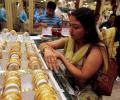
Jewellers across the country will go on a 'token strike' on August 23 against the "arbitrary implementation" of mandatory hallmarking of gold jewellery, All India Gem and Jewellery Domestic Council (GJC) said on Friday. The strike will be supported by 350 associations and federations from all four zones of the entire gems and jewellery industry, the GJC claimed. Mandatory gold hallmarking has come into force from June 16 in a phased manner. The government has identified 256 districts from 28 states and union territories for the phase-1 implementation.

India's good fortune, experts in the US feel, is not the result of a fundamentally strong economy, but because it is the best of a bad set of options.

The government clarified that the majority of industrial establishments had reported nil production, and cautioned that the numbers should not be compared with those of previous months. "It is not appropriate to compare the IIP of April 2020 with that of earlier months, and users may like to observe the changes in the IIP in the following months," said the ministry of statistics & programme implementation.

Investors took the Yes Bank event negatively because it raises a question on the stability of the overall Indian financial system.

he 2014 electoral verdict has bolstered investor confidence and raised hopes of economic revival, apex banks says in its monthly Bulletin
Some of the top indebted companies likely to face financial headwinds in the coming quarters include NTPC, PowerGrid, Tata Steel, Adani Power, JSW Steel, UPL, and Steel Authority of India. Together these 201 companies owed Rs 14.9 trillion to their lenders at the end of September 30, 2019, up 4.1 per cent year-on-year (YoY) during the first half of FY20.
The biggest losers in the Sensex pack were Vedanta, Tata Steel, M&M, Tata Motors, Maruti, Hero MotoCorp, PowerGrid, Bharti Airtel, SBI and Coal India -- falling up to 4.48 per cent.

In the Sensex pack, Yes bank emerged as the biggest loser, falling 9.13 per cent, followed by IndusInd Bank (6.6 per cent), HeroMotoCorp (6.01 per cent), Sun Pharma (4.79 per cent) and SBI (4.70 per cent).

Gold, forex assets, IT sector, pharma. Devangshu Datta explains why each of these is a good hedge against market shocks at this time.

Low home loan rates by banks could put large players in an advantageous position over smaller non-bank players, believe analysts.

Markets
ONGC was the top loser in the Sensex pack, shedding 4 per cent, followed by Bharti Airtel, SBI, IndusInd Bank, NTPC, Sun Pharma and ITC. On the other hand, Bajaj Finance, Bajaj Auto, Reliance, Bajaj Finserv and Asian Paints were among the gainers.

All Sensex components ended in green, with Bajaj Finserv, HCL Tech, Bharti Airtel, IndusInd Bank, L&T, TCS, ONGC and ICICI Bank, Bajaj Finance and SBI gaining up to 6.64 per cent.

ONGC was the top loser in the Sensex pack, shedding around 5 per cent, followed by SBI, Axis Bank, ICICI Bank, Bajaj Auto and Maruti. On the other hand, IndusInd Bank, HUL, Dr Reddy's, NTPC and Reliance Industries were among the gainers.

While Vedanta was the biggest gainer in the Sensex pack rallying 4.67 per cent, others included Tata Steel, ONGC, NTPC, Yes Bank, Infosys, Sun Pharma, Bharti Airtel, SBI, Bajaj Finance, L&T and RIL, rising up to 4.13 per cent.

The survey covered around 3,000 units from sectors like textiles, gems and jewellery, metal and metal products, leather, automobiles, as well as infotech and business process outsourcing. The latest survey says total employment in the surveyed units was 15.72 million. This is less than the 16.2 million jobs in the same units seen in September 2008.
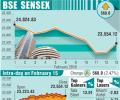
UltraTech Cement was the top gainer in the Sensex pack, rising 3.06 per cent, followed by IndusInd Bank, ICICI Bank, HDFC Bank, Titan, Axis Bank, SBI and Reliance Industries. NSE Nifty advanced 78.35 pointsto close at 14,814.75.

Over the next three - six months, UBS believes earnings will be the main driver for EM equities outperformance.
Other losers included Vedanta, Tata Steel, NTPC, ONGC, L&T, M&M, Coal India, Maruti, PowerGrid, Axis Bank, ITC and HDFC, dropping up to 5.75 per cent. On the other hand, Kotak Bank, Bharti Airtel, HCL Tech, Bajaj Finance and Hero MotoCorp rose up to 0.95 per cent.

'If an investor is ready to stay put for the next five years, one can consider investing in mid- and small-cap funds, but through SIPs.'
PowerGrid was the top gainer in the Sensex pack, spurting 2.76 per cent, followed by NTPC, M&M, L&T, Hindustan Unilever, HDFC, and Infosys.
On the Sensex chart, Axis Bank, Titan, IndusInd Bank, HDFC Bank, Dr Reddy's, HDFC and Asian Paint were major losers.


TCS was the top gainer in the Sensex pack, rising around 4 per cent, followed by ONGC, ICICI Bank, HDFC Bank, Dr Reddy's, HDFC and HCL Tech. NSE Nifty advanced 76.65 points to 14,581.45.

Automobile company Tata Motors, metals and mining major Vedanta, oil marketing firm Bharat Petroleum Corporation (BPCL), private sector IndusInd Bank, and two-wheeler major Bajaj Auto have witnessed their market cap slip below the Rs 1-trillion mark this year.

ONGC was the top loser in the Sensex pack, shedding around 5 per cent, followed by Sun Pharma, PowerGrid, Bajaj Finance, IndusInd Bank, Dr Reddy's and Maruti. On the other hand, Reliance Industries, Titan, HDFC Bank and ITC were the gainers.

In the past two months alone, four companies have garnered a cumulative Rs 22,400 crore via this route.

ITC was the top gainer in the Sensex pack, rallying over 7 per cent, followed by Asian Paints, Hero MotoCorp, Maruti, Bajaj Auto, Sun Pharma, TCS and HCL Tech. On the other hand, IndusInd Bank, NTPC, Bajaj Finance, HDFC and L&T were among the laggards. NSE Nifty advanced 39.70 points, or 0.44 per cent, to 9,106.25.
Kotak Bank was the top laggard in the Sensex pack, shedding over 2 per cent, followed by ITC, PowerGrid, M&M, HDFC, Asian Paints and NTPC. On the other hand, Maruti rallied over 4 per cent. Bharti Airtel, Axis Bank, IndusInd Bank and Bajaj Finance were also among the gainers.

The gems and jewellery industry is staring at a sales washout on Akshaya Tritiya for the second consecutive year as most of the states are under lockdowns due to the raging second wave of the COVID-19 pandemic which has led to negative consumer sentiment, say industry leaders. Akshaya Tritiya, considered as an auspicious day for buying gold and jewellery, falls on May 14 this year. India is the worst-hit among all nations with the second wave of the pandemic, which has been killing more than 3,500 daily and infecting close to 4 lakhs daily for weeks. The massive caseload has nearly paralysed the medical infrastructure.
 © 2026 Rediff.com - Advertise with us - Disclaimer - Privacy Policy - Sitemap - Feedback - About us - Terms of use - Grievances